

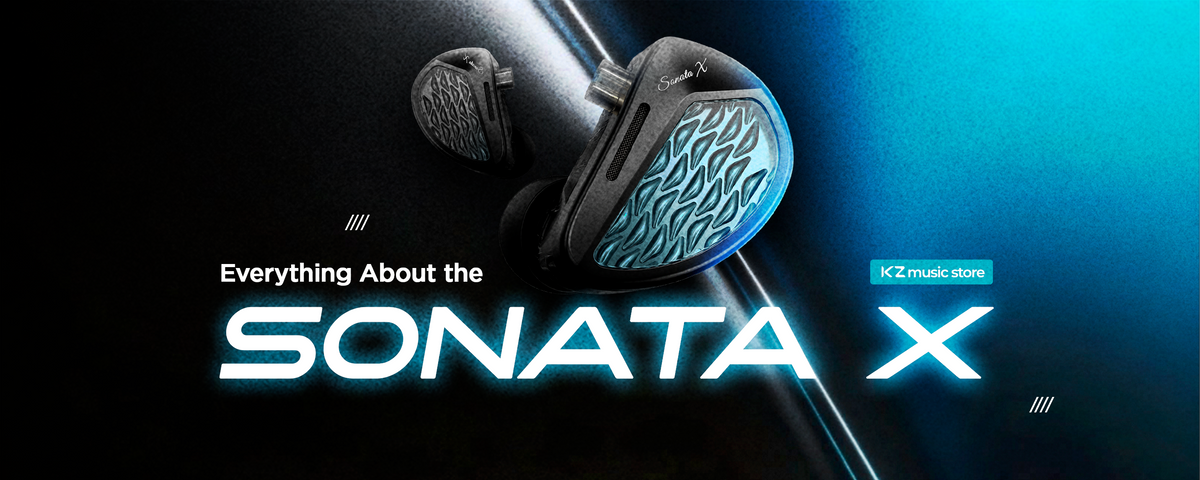
In a market where big numbers on spec sheets tend to attract attention, the KZ Sonata X offers a proposition that goes beyond simply increasing the number of components.
The second generation of the Sonata series is built around an architecture featuring 28 balanced armature drivers, 14 on each side, distributed across four frequency bands. KZ has also redesigned the acoustic structure, updated the driver responsible for bass reproduction, and added an adjustment system that allows users to customize the earphones' sound signature.
But what does all of this mean in practice?
28 Drivers Don't Mean 28 Times More Sound
The main highlight of the Sonata X isn't just the number of drivers, but how they are arranged.
Each earpiece houses 14 balanced armatures, divided into four groups responsible for different regions of the sound spectrum. One set is dedicated to ultra-high frequencies, another to upper mids, another to mids, and a dedicated low-frequency driver handles the bass.
This division allows different elements of the music to be reproduced by specialized components.
In practice, this helps deliver instrument separation, detail retrieval, and a more organized presentation, especially in tracks with many elements playing simultaneously.
Four-Way Crossover for a More Organized Frequency Spectrum
To coordinate this architecture, the Sonata X uses a four-way electronic crossover.
Rather than having all drivers work across the same frequency range, the system directs each region to the group of drivers responsible for it. According to KZ, this architecture reduces overlap between frequency bands and helps improve separation and playback coherence.
This is an important distinction because, in a multi-driver design, simply adding more components isn't enough. They need to work together in a coordinated way.
A New Approach to Bass
One of the most important changes in this generation lies in the very region that tends to attract the most attention in an earphone: the bass.
The Sonata X features a second-generation version of the 22955 BA, with modifications to its magnetic circuit and diaphragm. According to KZ, this redesign aims to extend bass response, deliver faster response times, and improve transient control.
This is particularly interesting for listeners who want impact without turning the low-frequency region into an indistinct mass of sound.
The goal is to maintain bass presence while preserving the definition of the other elements in the music.
Your Sound Doesn't Have to Be Fixed
Another standout feature of the Sonata X is its four acoustic tuning switches.
They allow users to modify the earphones' response directly through the physical structure of the product. The first two switches affect the bass, while the next two allow for progressively reducing the ultra-high-frequency region.
This creates different tuning possibilities without having to switch earphones.
Listeners who prefer a fuller presentation can boost the bass. Those looking for a smoother response in the higher frequencies can use the corresponding switches to reduce that region.
This is a particularly interesting feature in a high-end IEM, as it makes sound customization a more personal experience.
A Completely Redesigned Acoustic Architecture
The work wasn't limited to the drivers.
KZ has also redesigned the Sonata X's internal acoustic structure, incorporating a high-precision 3D-printed resin cavity. According to the manufacturer, this construction was developed to improve acoustic stability, reduce internal resonances, and deliver greater consistency in sound reproduction.
The design also aims to improve instrument positioning and the perception of soundstage depth.
This is particularly relevant in an IEM with so many drivers, since the physical arrangement of the components is part of its overall acoustic performance.
A Response That Goes Beyond the Conventional Audible Range
The Sonata X has a specified frequency response of 20 Hz to 40 kHz, with an impedance of 24–28 Ω and a sensitivity of 111 dB.
It's worth remembering that a wider frequency range alone doesn't determine whether an earphone is better. What really matters is how that range is used within the acoustic design.
In the Sonata X, it's part of a wideband reproduction approach, supported by dedicated drivers for different regions of the sound spectrum.
A Flagship Designed for Those Who Want to Explore Audio
The KZ Sonata X occupies a different position within the brand's lineup.
It wasn't developed simply to be an earphone with lots of drivers. Its proposition combines a multi-driver architecture, a four-way crossover, a new bass system, sound signature adjustments, and a redesigned acoustic structure.
That's why it makes more sense to see it as a high-resolution audio platform rather than just another IEM with an impressive spec sheet.
For audiophiles, musicians, producers, and listeners who enjoy exploring different aspects of audio, the combination of a 28-driver architecture and physical sound tuning switches makes the Sonata X particularly interesting.
In Summary
The Sonata X represents the evolution of the original Sonata series.
It features 28 balanced armature drivers, 14 per side, arranged across four frequency bands, a four-way electronic crossover, a new 22955 bass driver, and four switches for customizing its response. The acoustic construction has also been redesigned to support this new architecture.
Rather than simply increasing the number of components, the second generation aims to give each part of the system a clearly defined role.
This is the KZ Sonata X.